
How Miniatures & Digital Tools Are Transforming Tabletop RPGs

Tabletop RPG is no longer a game that can be played with a pencil, paper, and some imagination. I am not saying that imagination is not king, I am just saying the king has a tailor. However, nowadays, the tabletop games are vastly improving, particularly those classics that have made it to the avid fanbase, such as Dungeons and Dragons, courtesy of the miniatures, maps, and electronic assistants.
So what are modern dungeon masters and players doing to level up their game with cool technology, imaginative tools and just plenty of steez? Let’s find out.
Miniatures: Tiny Heroes Big Impact
Miniatures are not new, they are just getting fancy. We are discussing well-detailed 3D printed minis of your favorite characters, terrifying dragons, and even entire towns! Whether you're printing them at home or picking up a pre-painted set from your favorite game shop, minis pack a serious visual punch. And then there is the pleasure of seeing your little bard confront a giant orc at the table? It was a moment that drew the whole table to the edge of their seat.
They don’t just add flair, they tell a story.
Imagine this: one of the party bards, 12 inches tall, 1 inch of confidence (or so) walks out on the battlefield. On the other side of the table a large orc miniature flexing its muscles, and wielding an axe. There is silence at the table. Everybody bends forward. Dice are held.
It is not only a game piece, but a stand off. And at that instant, that little bard is not plastic. They are a hero who stands tall in adverse possibilities. That is what the magic minis bring into the equation: not only detail, but drama.

Maps & 3D Terrain: Building Worlds You Can Touch
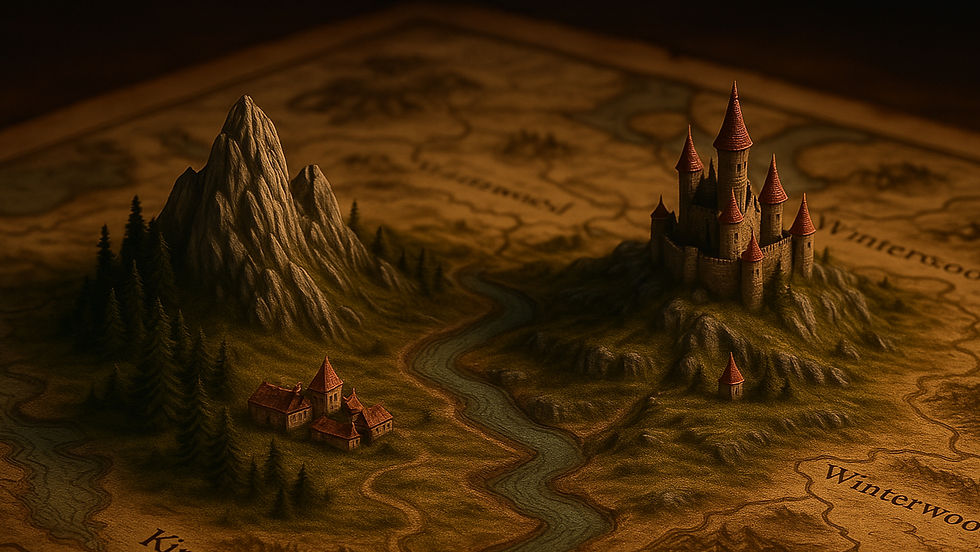
Nothing stops you from running an excellent session with a pad of blank grids and a good old dry-erase marker. That old way continues to have magic effects still. However, should you really want to impress your players? Your not-so-secret weapon is custom DnD maps and 3D printed terrain. You could walk into a session and have a dungeon literally laid before you more or less chunked out into glowing crystal lumps, cracked stone bridges, foggy frozen haunted forests, or even a castle in the air, staggering in mid-bolt. It is no longer just the theater of the mind, it is a mini movie set made purposely for your party.
Thanks to 3D printing, foam building, and modular terrain sets, however, dungeon masters are now transforming their tables into live-action movie sets. Imagine high cliffs or lava flowing rivers or cursed temples straight out of a board.
And the best part? These settings change the game. A narrow ledge means real danger. A glowing rune tile might hide a trap. Suddenly, your rogue’s “I sneak ahead” move becomes a whole lot riskier and everyone starts paying more attention to positioning and tactics.
Players stop just imagining the world and start reacting to it. And that changes everything.
Virtual Tabletops: The Adventure Continues From Anywhere
Then came the game-changer, the Virtual Tabletop (VTT). Gaming tools such as Roll20, Foundry VTT and Owlbear Rodeo have turned remote play into a compromise-no-more degree-of-immersion.
Your party members do not have to be seated at the same kitchen table with a VTT; you just need some sort of a screen. You may transfer tokens, unveil fog of war terrain maps, dice roll with animations, chat or make real-time voice calls and all of that using your browser. One can think of it as a digital battlemat with an embedded toolkit both to DMs and players as well.
It does not matter whether your rogue now resides in New York, your barbarian has relocated to Tokyo, or your cleric never leaves his couch because distance no longer matters whatsoever. It is like you and all are back at this enchanted table, huddling around the same one again with VTTs.
Even cooler? Others allow you to load custom maps, spikey lighting, atmospheric sound effects and itemized monsters stat-blocks, so your game can come as close to a video game experience all while keeping the creativity and chaos of classic tabletop play.

Dungeon Master Tools: Your Digital Spellbook
It makes sense that being a Dungeon Master is a lot. You are not only running a game but you are the storyteller, cartographer, rules referee, and expert improvisor. Being a one man production team of a fantasy epic is like it... each and every week.
However bullish that is, here is the good news; you no longer have to do all these on your own.
Thanks to powerful digital tools like D&D Beyond, World Anvil, and Campaign Logger, keeping your campaign organized is no longer a chaotic mess of sticky notes and half-lost spreadsheets. These platforms act like a magical assistant for modern DMs.
Interested in keeping an inventory of your party, spells, hit points and backstories? With D&D Beyond, the management of characters is very easy, including the fact that it can be linked to official material, so you will no longer have to go through rulebooks in the course of a game.
Okay, some of them even allow you to auto-roll initiative, prepare monster statistics, and combat encounters so you can have some free time and brain power to create exciting tales.
In short, you get to spend less time stressing over logistics and more time being an awesome storyteller. Now that’s actually a dungeon master’s win.
Digital vs Physical RPG Gear
There are some players who enjoy rolling actual dice and recording notes on paper. Some enjoy electronic character sheets, automatic damage calculation and glitzy looking PDFs.
There is no correct answer, to be honest. Most combinations get it confused and have physical maps and miniatures on the table, with paper tablets or laptops to detail character sheets and notes. Making the game more fun to your group will depend on what you are doing.
Some tables feel more alive with the clatter of real dice, the smell of old books, and a physical character sheet filled with doodles and smudges. Others love the clean efficiency of apps that track health, spells, and initiative with a tap. And then there are groups who do both, rolling dice by hand while referencing spells on a tablet, sketching maps in a notebook while using a VTT to track combat.
It is all a matter of finding what fits your group's style. Perhaps your dungeon masters prefer maps rather than digital notes, but the players would like them. Perhaps they all bring laptop computers, yet cling to a dice tray made of leather and a set of hand painted minis.
What is right and wrong is what will work best for you. The devices are to complement the story, but not to characterize it. The laughs, the tension and the epic moments you create together in the rolls of natural 20s on a scarred wooden piece of furniture or rolling over a blazing digital interface are what is truly magical about it.

New Age of Tabletop!
Dungeon master or dice-loving adventurer, there are few denying that the hobby is changing thanks to miniatures and game aids. Games are more immersive, easier to run, and more accessible than ever. With detailed minis, slick digital tools, and stunning maps, it’s never been easier to bring your world to life and get everyone around the table, real or virtual.
It’s not just about convenience, though. These new tools spark creativity. They bring fantasy worlds to life in stunning new ways, whether it’s a hand-painted dragon miniature towering over the party or a glowing, animated map of a volcano lair on a screen.
So grab your favorite mini, boot up your virtual tabletop, and roll for initiative, the adventure has only just begun.


Comments